
Complicating Coins; Coins Complicating History.
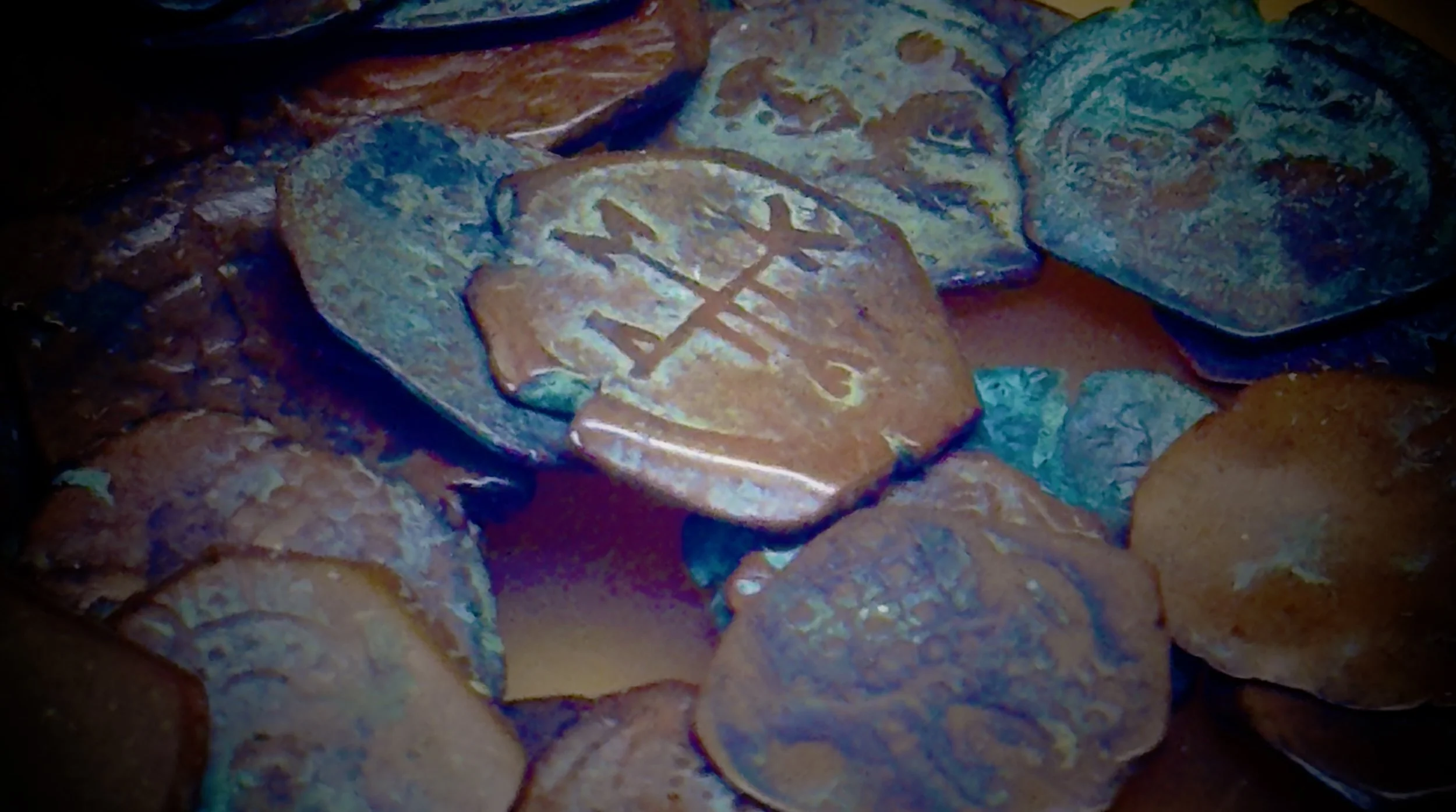
Tetartera of Manuel I Komnenos (1143-1180 CE). Numismatic Museum, Athens, Greece. Photo: Scott Coleman
Today I want to briefly address a few items. First, I have created a new logo and started to brand the blog in a new direction. My hope is to attract more readers and expand the types of content I produce. See below for the three variations of the new logo.



I have also begun updating the Rogue History Notebook. Because I have been very distracted by personal 'happenings' in my life this past year, I was not fully dedicated to maintaining the notebook. I am attempting to change this as I write my dissertation. I will begin publishing draft copies of my chapters soon...When I get over the anxiety of publishing my work. It seems weird, given I publish other items, but obtaining a PhD is something I have always wanted, and publishing working rough drafts of my dissertation chapters onto the notebook website is terrifying. But I will get over it, soon, I hope. I also need to reassess the front matter of the notebook and its subsequent pages, as I have revamped the chapter structure, identifiers and how notes are categorized, etc. Stay tuned.
FYI:
You can find and read this post and my digital notebook at the Rogue History Notebook, under the folder 35 Rogue History Blog, and engage with my notes that support this post through the tags and wikilinks. Go check out. Maybe you might find some interesting tidbits.
Next, my goal today is to complete some OCR of 17th-19th-century manuscripts. The objective is to transcribe these Latin, French and English texts into a plain text format in order to perform topic modelling and do a distant reading of general word associations and centres of gravity. For example, if the author identifies Anastasius I as the beginning of 'Byzantine' type coins, I want to know what other language is associated with the term 'Byzantine'. Did the author call them Greeks or Romans? Did he (all these early numismatists were generally very elite, high-status men with too much time on their hands) interchange Byzantine with l'Empire des Grecs or l'Empire d'Orient? FYI, in numismatics, Anastasius is the accepted starting point for so-called 'Byzantine' coins. I have serious concerns about this periodization with respect to the public reception of Roman continuity in the Eastern regions of the polity (empire), which I address in my dissertation.
This leads me to the complicated positionality of so-called 'Byzantine' coins in narrative construction. This sentence implies multiple obstacles that historians, archaeologists, numismatists, and public historians must consider when using coins as evidence to construct narratives about the Roman past. 'Positionality' also suggests that coins have an agency of their own that intersects with many social, cultural, political, and economic variables, both from the past and the contemporary period (Kemmers & Myrberg, 2011). A coin's agency shapes how we conduct research on it; traditionally, coins were isolated pieces of art and/or economic objects. Studied away from their archaeological contexts. Used to date stratigraphy, when possible, then sent off to the numismatists to do their thang.
In my dissertation, I apply a theoretical model called Object-Oriented Ontology (Harman & Witmore, 2023). My goal is to understand the 'Byzantine' identifier as a colonial tool rather than an arbitrary colonial label for a group of people who were Roman but not quite Roman enough for early modern antiquarians and scholars. Object-Oriented Ontology (OOO) shifts our focus from a human-centred positionality to an object-centred one. Understanding that objects (material culture) from the ancient and medieval worlds are entangled with our present, first and foremost, before showing their past. As Harman and Witmore note, "a past never existed in the same way as what becomes of it in our present" (Harman & Witmore, 2023: 14). And when we use a dishonest label to describe a coin as Byzantine, we place it in a calculated subordinate position, skewing our understanding of its probable history. We actively compress time and space rather than observe and receive the object's qualities in a more holistic manner.
Thus, for example, a Roman Tetarteron, when identified as 'Byzantine,' no longer projects its potential diverse and complicated past to us, but instead becomes a colonial tool that shifts our gaze to an imaginary period. It renders stereotypes, tropes, and all kinds of shittiness onto the coin. Now, some will argue that as specialists, we know they were Roman and 'Byzantine' is simply a classification used for 150 plus years or so, which is difficult to toss away. But as Leonora Neville (2025) notes, and I am in complete agreement, such arguments are a form of intellectual laziness and lack academic integrity.
But if we change the discipline's name to, say, for example, East Roman Numismatics or Medieval Numismatics, we must also then consider how to clarify this for non-specialists. And for the time being, Neville claims, "this [can be] done easily with a few words and then can be dropped for the duration of the study" (Neville, 2025: 52).
With respect to Leonora Neville, whose work I deeply admire and that has a significant impact on the direction of my research, this may be a suitable solution for manuscripts, articles and conferences (or any public speaking engagement); it is, however, not a suitable solution for digital infrastructure and Large Language Models. One complicating factor is the increased use of generative AI models like ChatGPT, Gemini, and Claude, which are now being used as advanced search engines. A lot of their training comes from sites like archive.org, which houses digitized manuscripts from the 15th to the 20th centuries and other materials that are no longer copyrighted. These sources are problematic on many fronts, and many numismatic sources use the label 'Byzantine' to identify and construct narratives about the medieval Eastern Roman world.
Thus, the trickle-down effect is the regurgitation and recycling that occur within these AI models, leading to the output of problematic and dishonest narratives concerning East Roman history. This will be addressed in my dissertation as well.
I should probably end this little rant by saying coins are complicated, and East Roman coins are far more complicated when the 'Byzantine' label is applied to them. This is just a sample of some of the issues I am working through, for which I do not have any concrete solutions. So, enjoy your weekend. More is on the way. Ciao.
References.
Harman, Graham and Christopher Witmore. 2023. Objects Untimely. Object-Oriented Philosophy and Archaeology. Polity Press, Cambridge, UK.
Kemmers, Fleur, and Nanouschka Myrberg. 2011. Rethinking Numismatics. The Archaeology of Coins. Archaeological Dialogues 18 (1): 87–108
Neville, Leonora. 2025. Sailing Away From Byzantium Toward East Roman History. New York: Cambridge University Press.
For a full bibliography, see the Rogue History Notebook (99 Bibliography).